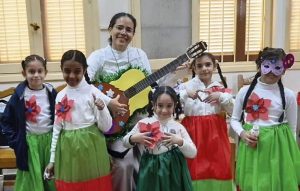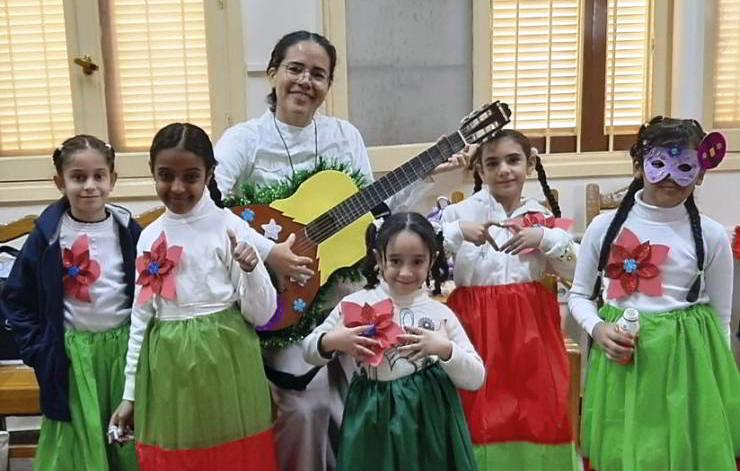
Sister Valeria Ruiz Sanchez Armida, a Comboni missionary, lives in Aswan, Egypt, and is a teacher. “In our school, we are building the future of Egypt and the dream of a more just humanity.”
I have lived in Egypt for four years, specifically in the Aswan mission. The context is very different from that of Peru, my home country. Learning Arabic and this ancient culture is a journey of commitment and humility for me. I am an English teacher and academic supervisor at Santa Teresa School, the only Catholic school in the region, founded in 1896, which serves students from preschool to secondary school.
As a Comboni Missionary Sister, I am proud to continue the legacy of Comboni in Egypt. Aware of the transformative power of education, he founded three institutes in Cairo to educate children, the youth, catechumens, and African women.
Today, as in the past, the schools of this country are places of encounter, dialogue, and hope. Ours, a Catholic school, opens its doors to Coptic Catholic, Coptic Orthodox, and Muslim children, becoming a unique space for coexistence and learning.
I’m discovering that true interreligious dialogue doesn’t happen in lectures or theological debates, but in the daily life of the classroom. Christian and Muslim children play, study, and help each other without prejudice.
This experience reveals that dialogue is embodied in coexistence. I remember well the story of Yusef, a hyperactive, intelligent, and extroverted third-grade boy, but unable to write a single sentence in Arabic or English. His homework was never up to par, and when I wanted to know why, he responded with silence. Consulting other teachers, I learned that his father never came to school and didn’t answer my calls. Attempts to contact his mother also proved fruitless.
With patience, I managed to get closer to Yusef and discovered that his father was practically absent from his life and that his mother often resorted to violence. He also revealed to me that his father had a new family and a newborn son. All of this explained Yusef’s restless and evasive behaviour, as well as his poor grades.
This experience made me realise that children are not the priority in many families. It is painful to see a child suffer from the absence and neglect of their parents, but this reality is urging me to seek ways in which schools and families may share the responsibility of a well-integrated education.
The interreligious dialogue in the classrooms, the unprejudiced coexistence among students, and Yusef’s story remind me that education is a bridge to peace and brotherhood. Every gesture of love can transform a child’s life. In our school, Egypt’s future and the dream of a more just humanity are being built.
Today, I reiterate the importance of carrying forward the educational legacy of Saint Daniel Comboni, especially in Arab countries, where the Gospel is silently proclaimed through service and daily witness.