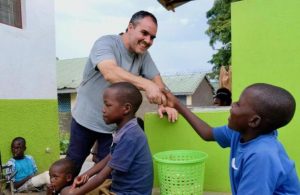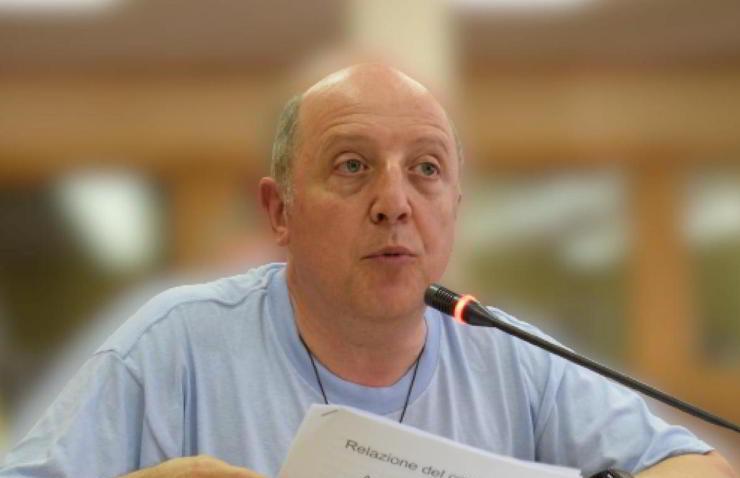
Brother Alberto Degan, a Comboni missionary, worked at the Afro-American Cultural Centre in Guayaquil, Ecuador. His mission was to bear witness to the Gospel, live in fraternity and help the Afro-American people become protagonists of their own history.
The Afro Cultural Centre in Guayaquil was founded by the Comboni Missionaries in 1980. It was the first centre in Latin America dedicated exclusively to the pastoral care of Afro-descendants, who are the poorest and most discriminated against in Ecuador. I worked at the Centre for about 15 years.
As a Comboni Brother, I am committed to promoting humanity, valorising human riches and forming people according to God’s plan. We want to enhance the human and spiritual beauty of those marginalised and overlooked by society.
In recent years, Guayaquil has achieved an unenviable distinction: it has entered the top 10 of the ten most violent cities in the world, with a rate of 80 homicides per 100,000 inhabitants (in 2025, Guayaquil accounted for 2,545 of Ecuador’s 9,235 homicides).
In fact, Ecuador was considered the sixth most dangerous country in the world in 2025 (data from ACLED — the Armed Conflict Location & Event Data Project), largely due to Mexican drug cartels entering the territory in 2017. The country has since become a major transit point for drugs. Consequently, almost all of the city’s neighbourhoods are now under the control of gangs linked to the cartels. These gangs impose a tax on all small business owners, even those who are just about managing to survive. Many give up the small businesses they started because the ‘tax’ makes them virtually non-profitable.
Adding to the tragedy of violence is the drama of social injustice: in Ecuador, inequality continues to grow. Many wealthy people have taken refuge in the small town of Samborondón, on the outskirts of Guayaquil. Safe in their “fortified” and protected citadels, they feel little threatened by the violence that, on the contrary, devastates the working-class neighbourhoods. Those who live here enjoy every comfort and every right, while a small elite holds most of the capital. More than a quarter of the population live in poverty.
We often ask ourselves: How can we live a beautiful life in a violent and unjust environment? Is it possible to live a beautiful life when we live in an unjust society? Is it possible to offer young people and children a beautiful life in a city dominated by violence? These are questions that stir the hearts of many Guayaquil residents. It is touching to see how so many people fight to live a beautiful life, even in such a difficult context.
I believe that this is precisely where the greatness of human beings lies: in never giving up on seeking beauty and goodness, even when everything seems to want us to give up. I am convinced that even in a violent city like Guayaquil, it is possible to live a beautiful life.
Jesus Christ came to teach us how to live a beautiful life in a violent world, and in Ecuador, I met many of the Master’s disciples who, in their simplicity, became my little teachers. My first teachers are the Afro-American missionaries, lay people of African origin trained in the Comboni spirituality of “Saving Africa with Africa,” who evangelise from the culture and spirituality of the Black people.
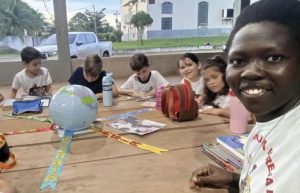
Despite living in the city’s most violent neighbourhoods, Gloria, Estela, Tomasa, Norma, and Carlos continue to organise children’s palenques in their homes [palenques were free communities, founded and self-managed by escaped slaves during the colonial period in the Americas]. Let’s not forget that mafiosi linked to drug trafficking try to recruit even children as young as 6 and 7.
These palenques are, therefore, alternative spaces where the builders of a different future can be educated, receiving a Christian education rooted in their Afro-American spirituality. In other words, we seek to save these children from the culture of violence so that, rooted in Jesus, they will not be seduced by the siren songs of easy profit associated with the criminality of drug trafficking.
Orfilia is another of my teachers. Twenty years ago, I was the one who showed her the outskirts of Guayaquil, where most of the black population lives. At first, she accompanied me a little fearfully. Years later, when I returned to Guayaquil, she was the one who often accompanied me to the outskirts, where few dare to venture.
Orfilia, who works as an accountant, with the help of some friends, developed a scholarship program for Afro-Ecuadorian children and adolescents a few years ago. She dedicates much of her time to monitoring the academic performance of these children, as well as organising extracurricular activities for them.
Rodrigo also taught me a great deal. He invited me to collaborate with a drug rehabilitation centre run by an evangelical church. This collaboration with evangelicals is wonderful, as it transcends the “rivalries” between different religious denominations. With these young people struggling to overcome drug addiction, we seek the path that leads to a fundamental change in their lives, a change impossible to achieve through human strength alone, but possible when we place ourselves in God’s hands.
Rodrigo, a young father, dedicates much of his time to these young people. Another of my teachers is Karen, who lives in Trinipuerto, one of the most violent neighbourhoods in the city. She works and devotes herself to her two children, but despite this—faithfully and reliably—she also finds time to meet with the neighbourhood children and the youth of the Afro Pastoral: she reads the Word of God with them and has managed to consolidate a healthy and supportive space in such a problematic context. Karen wants to save these young people from a culture of violence and resignation, giving them the motivation to continue walking on and struggling with unwavering hope.
As long as there are people like Rodrigo, Orfilia, Carlos, and Karen, who continue to bear witness to the beauty of the Gospel in such a difficult context, I see a great future for this country. We Comboni Brothers accompany and feel accompanied by these people: in such a difficult situation, we support one another and, in this fraternity, we experience mutual love and consolation. In this way, God gives us the strength to keep going forward, never giving up hope.