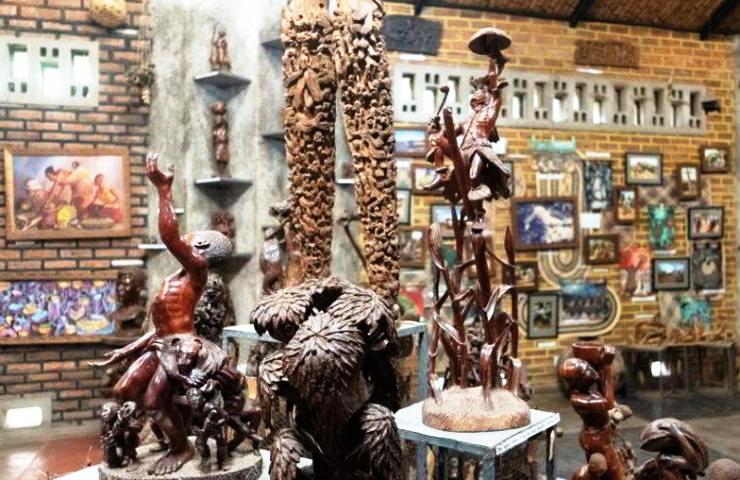
This year the Kungoni Culture and Art Centre celebrate fifty years of life. A meeting place to understand the cultural, artistic and anthropological part of the country. We went to visit it.
The Mua mission, located in the district of Dedza – in the central region – was founded in 1902 and was one of the first Catholic missions in the country. Over time, the French-Canadian Father Claude Boucher Chisale arrived there and founded the Kungoni Centre for Culture and Art. He passed away a few years ago, and his successor at the helm of this initiative is Father Brendan O’Shea, who claims that what inspired the then-young Father Boucher was the “breath of change that blew in the Church” after the Second Vatican Council.
For Father O’Shea, an anthropologist originally from the south-west of Ireland, the mission of 1902 “represented more a competition between culture and faith than a complementarity”. And he adds: “Kungoni wanted to question all this. We could not go back and erase the past, but we wanted to propose an alternative and a new form of evangelization, a new way of relating to history and the culture of the people”. This is why, as the Irish missionary says, much of the work done in the centre concerns inculturation, the dialogue between culture and faith.
The Centre for Culture and Art was born almost as a result of anthropological and ethnographic work, and from the desire of Father Claude and his team to immerse themselves in local culture and history, which “meant spending a lot of time with people, collecting their stories, collecting objects and listening to how they interpret their lives, their faith and their culture,” Fr. O’Shea explains.
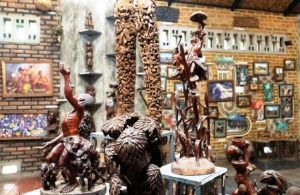
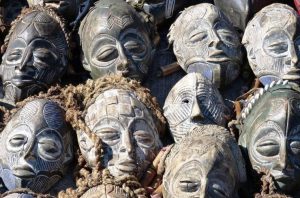
Father Boucher and his team collected numerous objects to form what would later become the Chamare Museum, destined to become the centrepiece of Kungoni. The museum, whose name is inspired by Jean-Martin Champmartin, a missionary who spent many years in Mua, is not only a place where this heritage is preserved, but also, as Father O’Shea points out, a “teaching tool for future generations of Malawians.”
However, the philosophy that inspired the centre was not confined within its walls, since another of Kungoni’s central themes, as Father Brendan recounts, “was the real freedom to experiment in matters of liturgy, singing and dance, and how all this could relate to our traditional forms of celebrating the liturgy.”
Although Kungoni was originally a renewal in many ways, it has never stopped evolving. One of the most obvious changes, and one of which Father O’Shea is particularly proud, is the growing number of Malawians who visit its facilities every year. While in the past visitors were mostly European tourists or workers in Malawi, in the last five years there has been a significant change that, as the director points out, is the result of the promotion and collaboration work carried out with educational institutions – from primary school to university – and with government institutions, such as the Ministry of Tourism.
For Brendan O’Shea this represents “wonderful progress”, because “in reality, Kungoni is for Malawi, for its Church and for its people. We are delighted that more and more Malawians are coming here to appreciate their history and culture”. This increase in local visitors has, without a doubt, a great impact on the younger generations.
“We live in a very digital, very modern world. One of the challenges I see beyond the centre, and which is one of our main concerns, concerns the school groups that come here. It worries me that schools have so little contact with their own history and culture,” says this missionary of the White Fathers.
To this he adds another challenge of an internal nature: the continuous care and maintenance required both by the objects of the museum, and by the archive centre – which has a multitude of documents, as well as audio and video recordings – and by the surrounding environment. As the director of the Kungoni says, “we try to keep it as green and lush as possible so that, when young people come here, they can see the benefits of caring for the environment.”
An annual cultural festival is organized that is considered the highlight of the year. The event takes place around a specific theme. In 2025, in the context of the presidential elections in the country, the theme was “Having a vision”, and the dances, songs and theatrical performances revolved around this idea.
But the festival is also intended as a space for dialogue between people of different religions – interfaith celebrations are organized with Muslim and Protestant leaders. The last and most important part of the festival is the Gule Wamkulu, a collective dance of the Chewa people in which, as in the rest of the scheduled initiatives, the theme of the festival is incorporated.
The Kungoni Culture and Art Centre, which has become a historical and ethnographic landmark for three of Malawi’s main ethnic groups – the Chewa, the Ngoni and the Yao – also reflects the tension between tradition and contemporaneity. Father Brendan O’Shea believes that positive values are useful and valid in any society and that, when you show the rites of passage from 30 or 40 years ago to the younger generation, you do not do it to encourage people to go back to the past, “but to show that those rites of passage existed to promote positive principles”.
The Irish missionary believes that while modern education “has been a wonderful gift,” it “should not come at the expense of traditional knowledge” of indigenous peoples. For him, it is a shame to break the link with that wisdom, as “we should also pay attention to these traditional forms of transmitting knowledge through song, dance, storytelling, riddles, and prose. They were valuable ways to share information with the next generation. It is there that fruitful dialogue can arise between traditional and contemporary knowledge and wisdom.”
In this context, however, they look to the future with enthusiasm. The director’s first plan of action is to create a group of young Malawians who will guide the future of the centre. Together with them, he is certain that they would like to get much more involved in schools, for example through cultural clubs or summer camps for children and young people. Finally, he believes it is important to devote more time to research in the future, visiting communities and resuming some of the original ethnographic and anthropological work.
Kungoni is a demonstration of the importance of investing in culture. Father Brendan O’Shea is clear about this choice. In his opinion, “We should not neglect culture to focus only on the economic aspects of life. It is as precious as anything else, because if we become a monolithic society, we will certainly lose an incredibly rich part of our identity.”
He adds: “We talk about identity building, and identity building is trust-building. Building trust helps people to have a vision of the future, to look forward. I think that’s why it’s worth investing in.” (Gonzalo Vitón) – (View of the art gallery at the Kungoni Centre).