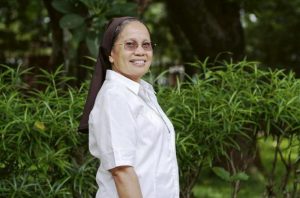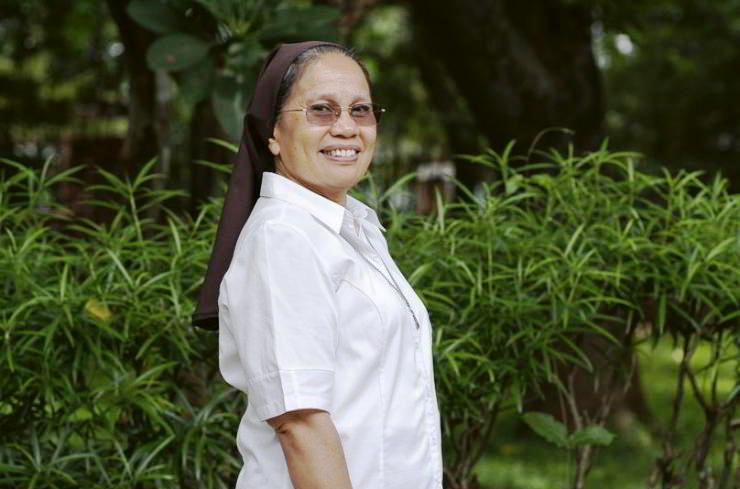
For twenty-one years, Sister Rose Guevara has been a missionary in Malawi, a country where she feels “at home.” She tells us about her vocational journey.
I am a Carmelite Missionary Sister originally from the Philippines. At home, I was the youngest of three siblings. My training as an engineer led me to work for a multinational company in Manila for several years. However, despite the job stability, I began to feel a deep restlessness. I felt that something essential was missing to give full meaning to my life.
Initially, I thought the answer might lie in better job opportunities or greater financial security. However, despite having achieved what many considered success, I felt an emptiness within me that money could not fill.
One day, while visiting some friends, I felt an inner calling that urged me to enter a church. However, I resisted. I kept telling myself that I didn’t have a natural inclination toward religion. I thought that perhaps what I needed was to seek new horizons, something more in tune with my adventurous spirit, like mountaineering, which really attracted me.
The second time I heard that invitation to enter a church, I couldn’t resist. After a work meeting where my integrity was questioned, I stormed out of the office, and my steps led me to San Lorenzo Church in Manila. There, in silence, a new attitude began to unfold within me.
In that church, I saw some posters offering a “challenge.” This word awakened something deep within me, perhaps because I’ve always been drawn to challenges and experiences that require dedication and self-improvement, like climbing. Among the images displayed on those posters, there was one in particular showing African children following a missionary on horseback.
I wrote down a phone number and called, without really knowing why. They gave me information about the next vocational orientation meeting, which would be held at the Scout Madriñan in Quezon City. Thus began my vocational journey. All this happened in the missionary month par excellence, October 1994.
The journey to that place was not easy. Even though I knew the city of Manila well, I got lost several times. After changing modes of transportation several times, I told myself that this would be my last attempt. If I couldn’t find the place, I would go home and forget about it. But on the way, a girl sitting next to me proved providential, because she was also on her way to the meeting. We arrived together at the community of the Carmelite Missionary Sisters.
Upon entering, my first impression was of bewilderment. Seeing so many religious sisters in prayer didn’t match the idea I had of my life. But something changed inside me, and I was enveloped in a profound serenity. I listened to the testimony of a nun who recounted her missionary experience in Kuwait, how she and her fellow nuns fled and hid during the war. Those words awakened an unexpected attraction in me.
For the first time, I thought that maybe this was the life I was looking for. After the meeting, the girl I’d arrived with became my companion on the journey.
A few weeks later, in December, she invited me to another meeting in Calambá, south of Manila. I asked her what it was about, and she replied that we were heading up the mountain. I thought it was just a hike, but once we arrived, a Carmelite nun surprised me with a direct question: “Why do you want to become a nun?” My response was immediate and sincere: “I don’t want to become a nun, even though your lifestyle appeals to me.”
At the end of the meeting, feeling disoriented, I began to sense that perhaps I should take a step further and open myself to the possibility of seeing where that path would lead me.
It wasn’t easy communicating my decision to my family. My parents reacted with surprise and opposition. My mother, for example, didn’t want to lose her only daughter: “I want you to have grandchildren for me,” she kept repeating. My father remained silent. Only my older brother offered me his support: “Don’t worry, sister, follow your heart’s desire, I will support you.” Those words gave me the strength to carry on. That evening, we had dinner in silence, then everyone went to their rooms without saying a word.
Shortly thereafter, I received a letter of acceptance. It was January, and I was supposed to join the nuns in Laguna in May. Work-wise, I had the promising prospect of promotion to company manager. However, I chose to follow the calling that was taking shape within me and submitted my resignation to the company manager.
My beginnings in the community were not without challenges. Household chores punctuated daily life: cleaning, gardening, washing and ironing… There were 23 of us, plus the nuns. After a week, I fell ill because I wasn’t used to such an intense workload. I had never done work like that in Manila. After two weeks, overwhelmed by community service, I expressed my discouragement to the nuns. I felt that this wasn’t the path I was meant to take.
Since the next day was a day of visitation, I told the nuns of my decision to return home to my parents. They serenely invited me to rest and to bring my worries to prayer. That night I said, “Lord, this is not the life I expected.” The next morning, the nuns asked me what time my parents would arrive and if I had already packed my things. My response was, “What for?” I was ashamed to admit that I wanted to abandon everything for something as simple as household chores. I decided to stay because I understood that a vocation is not based on romantic ideals, but on daily fidelity.
As time passed, I took decisive steps. I made my first religious profession in 1999 and my perpetual profession in 2005 in Manila. Shortly before the latter, I expressed my desire to be sent to Africa. It was a dream I had nurtured since I was very young, so when the superior told me of my destination, I welcomed it with joy. My arrival in Africa marked a before and after.
In July 2005, after a brief stay in Kenya and Tanzania, I was sent to Malawi, to the Kapiri community. Once I arrived, I found myself having to manage the hospital’s administration, a task for which I felt unprepared. Among my responsibilities was the purchase of medicines and medical equipment. I had no idea where to begin. Once again, it was my studies that allowed me to develop and, over time, respond to the hospital’s concrete needs.
The challenges were many: language, culture, lack of resources, and material limitations. I was sent to study Chichewa, but the hospital emergency meant that, just two days later, I had to join the nursing duties. In the end, I taught myself the language, using the means at my disposal: reading books, because the internet wasn’t yet available.
In Kapiri, where I am still working, the socioeconomic situation of the population is precarious. The population lives mostly on subsistence agriculture, which even affects access to medical care. There are many cases where patients cannot afford hospital bills because they are still waiting for the harvest. Faced with this situation, we decided to assist them and wait until they sold their harvest and then pay for the care we provided.
Despite the difficulties, I deeply love Malawi and its people. I feel at home here. After 21 years in the country, I now understand clearly that my vocation is tied to this land. However, I remain open to any destination my congregation deems appropriate. (Photo: Boniface Gbama)