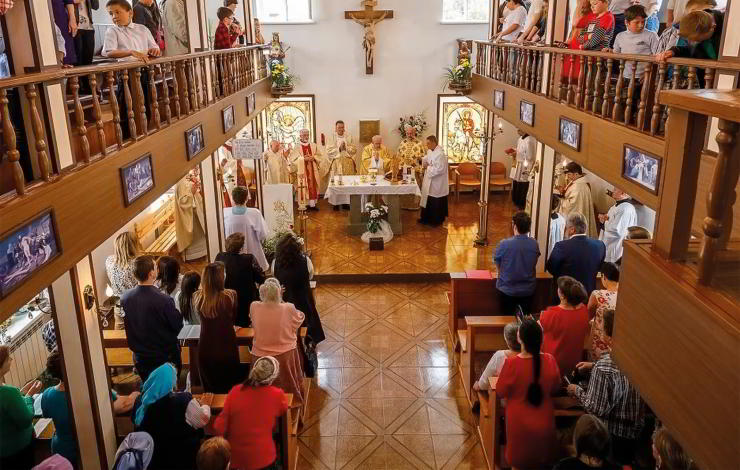
Leading a small Christian community in Kyrgyzstan, Mons. Anthony Corcoran, apostolic administrator of the Central Asian country, says: “I discovered their extraordinary testimony, the strength of their faith, and their integrity in guarding it, which makes it the key to their lives.”
A few hundred Catholics in a country of over 7 million people. This is the tiny flock shepherded in Kyrgyzstan by Mons. Anthony Corcoran, apostolic administrator of the tiny Church in this Central Asian country. A handful of Catholics in Bishkek—the capital of a Muslim-majority country—have their point of reference in the tiny and simple Church of St. Michael.
“I arrived in Novosibirsk, Siberia, in 1997,” says Father Anthony, a 62-year-old Jesuit originally from Texas, “just eight years after the fall of the Berlin Wall in 1989. Our mission from the beginning was to serve those Catholics who, despite countless difficulties, had managed to keep their faith alive here: there were elderly people who hadn’t seen a priest since the Second World War. Young people who had never attended Mass or received the sacraments.”
“In those years, I saw firsthand the consequences of the Soviet era; but I also discovered the extraordinary testimony of the Catholics who remained there: the strength of their faith and their integrity in preserving it, making it the key to their lives.”
Where do the Catholics living in the countries of the former Soviet Union come from? “In Siberia, most of them were the so-called ‘Volga Germans,’ an ethnic minority who settled in Russia in the eighteenth century and were arrested by Stalin and deported in 1941,” explains Father Corcoran.
“At the end of the 1990s, some of these people were still alive; I met them. Others were Poles from eastern Ukraine or parts of Belarus, or Lithuanians. Alongside them were their children and grandchildren, who, naturally, had assimilated more fully into Russian society.”
Mons. Anthony spent 13 years with them in Novosibirsk, until 2010, when he was appointed regional superior of the Jesuits, responsible for a missionary presence across a vast territory that includes not only Russia but also Ukraine, Belarus, and Central Asia. This ministry also includes the delicate challenge of ecumenical relations with the Orthodox communities.
Finally, in 2017, Pope Francis called him to Kyrgyzstan to serve as the apostolic administrator, that is, the leader of this tiny Catholic community that, from a canon law perspective, is still too small to have a bishop. On 26 May of this year, Pope Leo XIV appointed him as a bishop.
“As in Siberia, many Catholics in Kyrgyzstan were of German or Polish origin, but most emigrated, returning to their ancestral lands,” the Jesuit continues. “Those who remained live their faith as they would anywhere else: we have a few parishes, the largest group in the capital, but we are also present in five other cities. All communities are evidently very small in scale: in total, we number just a few hundred. Pope Francis called our Churches in Central Asia ‘the little flock,’ and it is a very beautiful image for us.”
“Serving these communities,” continues Mons. Corcoran, “has taught me God’s providence and His action through the Church. I think of an image I heard from a babushka speaking to her granddaughter, many years ago. She showed her an Advent wreath that still had only one candle lit and said, “See? If I put it out, everything would remain dark. But next week there will be two candles, and there will be so much light.”
“You too, if you carry this flame with you, if you keep it burning, when you meet someone else, together you will form something that is much more than two lights.” That woman had summed up well the task of every Christian. It is no coincidence that the Catholic Church is present in frontier lands. Our task is to be there, bearing witness to our faith and collaborating for the common good with every person of good will.
How can we live out this commitment in a country like Kyrgyzstan? “Here too,” Mons. Corcoran responds, “we are dealing with the changes that are sweeping the world today. In our society, for example, the search for one’s own identity is emerging. The models and solutions of the past are no longer sufficient; people are trying to understand what it means to live in the world. This leads us Christians to engage with everyone else on some major challenges: the formation and education of young people, and the care of vulnerable people, both economically and in every other dimension.”
All this at a crossroads between Russia, China, and Europe, a country that—for geopolitical and commercial reasons, among others—has attracted considerable attention in recent years. “Central Asia is a fascinating region, even though many people, not only in the West, know very little about it,” comments the Jesuit missionary.
“It has its own culture, history, and unique way of experiencing religion. The passage of the ancient Silk Road through these lands has left profound traces, making it a fascinating place not only geographically, but also demographically, economically, religiously, and socially. And it is a region where ethnic groups with very different characteristics live side by side.”
Christianity itself in Kyrgyzstan has much older roots than one might think. “From an archaeological perspective,” he recalls, “evidence has been found of the presence of Syriac Christians in the first millennium. I heard a local scholar say that the more you look, the more you discover that their presence was widespread and perhaps even older than previously thought. After all, boundaries were blurred back then: along the Silk Road, different religions coexisted. Communities were found living side by side, with nearby cemeteries and shared markets. All of this influenced the character of the peoples of the region.”
This is an invaluable trait in today’s world: “While maintaining their own culture,” observes Mons. Corcoran, “the Kyrgyz tend to seek common ground with other peoples. I don’t say this as a compliment: I’ve experienced it firsthand over the years. They are healthily proud of their history, but they don’t like radicalism. This allows them to collaborate with other peoples and groups with relative ease.” This also applies, of course, to local Islam: “The vast majority of Kyrgyz Muslims have good relations with us. The government ensures that there are no radical external influences. If there is any form of religious or political extremism, it’s probably imported. But it’s not the dominant current.”
In this context, the Church remains a tiny seed, yet is happy to feel part of something larger. “Our Catholics,” says Mons. Anthony, “now all have parents or grandparents born in Kyrgyzstan; they recognize themselves as full citizens of this country, and they contribute to the development of local society. But they also feel they belong to the universal Church. And this is fundamental to their identity: for them, it’s a very beautiful experience when they happen to meet Catholics from other countries. It reminds them that they’re not following just another group, but Christ.”
This “little flock” also has another important message for everyone about the mission. “Our Church,” concludes the apostolic administrator of Kyrgyzstan, “has no great numbers or successes to boast about. Our experience, however, can perhaps serve to remind everyone that if we are Christians, it is because one day someone spoke a word that gave us life, hope, and meaning in this world, even opening us to the prospect of eternal life.”
“We Catholics tend to pray little for those who transmitted the faith to us. Living in Kyrgyzstan has made me understand that mission isn’t just a matter of more or less remote countries; it’s also a geography of hearts, minds, and souls to be rediscovered. To truly be disciples of Jesus.” (Giorgio Bernardelli/MM)