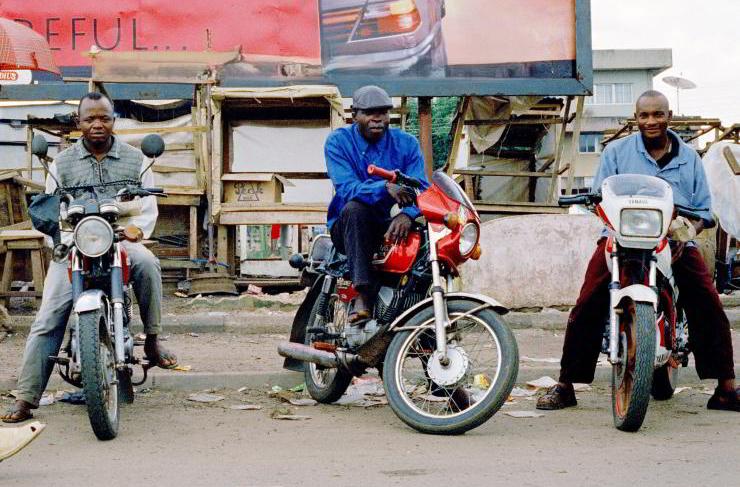
Motorcycles in Nigeria are more than a means of transportation: they drive the informal economy, challenge the rules, and prepare for the electric transition. Between tradition and innovation, the two-wheel revolution is only just beginning.
In Nigeria, motorcycles and scooters are more than just means of transportation and drivers of the informal economy: they embody the dynamism and creativity of a country constantly on the move. Essential to tens of millions of people, they ensure rapid and economical travel in chaotic metropolises and rural areas, where roads often make it impossible for cars to pass.
The spread of motorised two-wheelers has given rise to a thriving market—driven more by imports than local production—that now faces new challenges and opportunities, especially with the advent of electric mobility. However, even before technological innovation, safety remains a crucial issue.
The streets are transforming into anarchic territories, where indiscipline reigns supreme. This perception is especially fuelled by the drivers of okadas, motorcycles used as public transportation, which offer a quick way to navigate congested traffic and reach areas not served by traditional means. The use of okadas is subject to regulations that vary by region and city.
In Lagos State, for example, authorities have imposed significant restrictions on the use of motorcycle taxis.
In 2020, a ban was introduced that limited their operation in several areas of the city, to reduce road accidents and improve public safety. However, the measure sparked protests among drivers and residents who depend on this mode of transportation for their daily commute.
In 2022, the Lagos government further extended the ban, banning motorcycle taxis from most city streets. The decision was made in response to safety concerns, as a significant percentage of road accidents were attributed to okadas.
Despite these restrictions in some urban areas, okadas continue to operate legally in many other parts of Nigeria and remain an essential component of the public transportation system, especially in rural or less developed areas where alternatives are limited. Therefore, despite legal restrictions, the use of motorcycles as public transportation remains widespread—and often characterised by unruly drivers. Even major international groups are targeting the Nigerian two-wheeler market.
With over 200 million inhabitants and limited infrastructure, two-wheelers are essential not only for passenger transportation but also for goods delivery and emergency services. Considered a versatile, reliable, and relatively affordable vehicle (compared to car prices), motorcycles are the object of a genuine passion, almost a veneration, in Nigeria that shows no sign of abating, even though the industry relies almost entirely on imported vehicles (produced in Asia) and fuel (refined in the West).
The Nigerian government is seeking to reduce dependence on imports through policies that incentivise local production, capitalising on the push toward sustainable mobility. Environmental challenges can represent an opportunity to develop a domestic “green” motorcycle industry.
Despite the predominance of traditional internal combustion engines (which still account for 89% of the global market), the motorcycle industry is increasingly focused on environmental sustainability. In Africa, and particularly in Nigeria, the adoption of electric motorcycles presents both opportunities and challenges.
A significant obstacle is the limited charging infrastructure and limited battery range. To overcome these difficulties, battery-swapping systems are being tested that enable the rapid replacement of depleted batteries with charged ones, reducing user downtime.
One example is the electric motorcycle produced by Kymco, a renowned Taiwanese company, distributed in Lagos and featuring a network of charging stations that enable a rapid recharge in 30 seconds. Taiwan has strengthened its partnerships with Nigeria to support the transition to electric mobility.
Local companies like AaraGO, a green technology startup that introduced innovative motorcycle technology two years ago, are also driving this change. The AaraGO battery swap service is designed to facilitate this transition. “Our motorcycles, powered entirely by solar-charged batteries, aim to mitigate air pollution, improve air quality, and reduce carbon emissions,” explains Handschin.
AaraGO’s solution is completely off-grid, meaning independent of the national grid, leveraging renewable energy to efficiently power transportation. “Nigeria has over five million motorcycles,” recalls Olumide Adeosun, an investor in the startup, led by young engineers and developers, “and each of them consumes five to seven litres of gasoline per day, which represents a huge opportunity to transition to cleaner energy.”
Meanwhile, Spiro, Africa’s largest electric vehicle manufacturer, has begun production of e-bikes, motorcycles, and electric tricycles in Ogun State, with the aim of reducing transportation costs and improving air quality.
Spiro’s logistics organisation enables riders to use battery-swapping stations—without waiting for charging—a flexible solution that ensures energy supply when and where needed. With over 18,000 electric motorcycles already distributed in sub-Saharan Africa, Spiro’s expansion into Nigeria—potentially the continent’s largest market—promises to be a historic event. “We plan to be present in eight of the country’s largest states, including Abeokuta, Ibadan, Lagos, and Abuja,” announced Spiro CEO Kaushik Burman, who promises: “We will distribute hundreds of thousands of motorcycles—reliable, quiet, and affordable—enabling a lifestyle shift toward cleaner and more sustainable transportation options. Our goal is to electrify mobility across Africa, and Nigeria, as Africa’s economic powerhouse, represents an important step on this journey.” (Habubakar Chibuike/Africa)