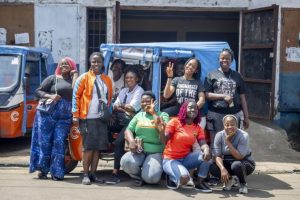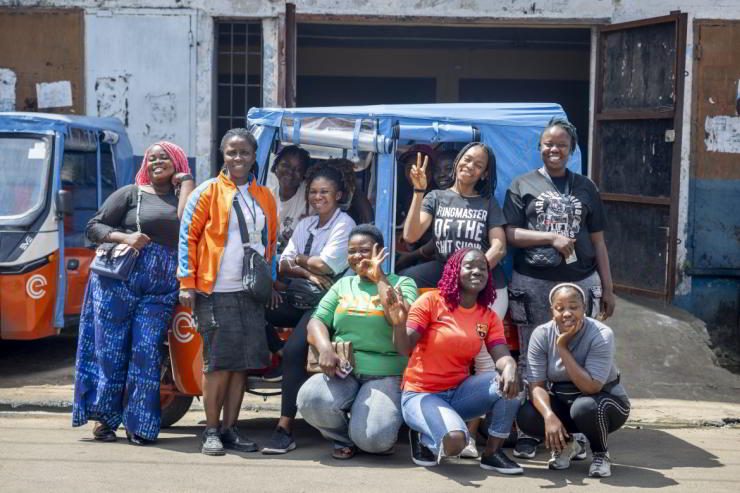
Elvis Thomas is a co-founder of a start-up that introduced the country’s first fleet of electric tuk-tuks. It is a project that combines sustainable mobility, inclusion, and employment, offering cleaner, safer transport while creating new economic opportunities for women.
The world is warming. Inequalities are increasing. Yet, in Africa and elsewhere, many young people are transforming the vulnerabilities of crisis-ridden systems into opportunities for change. In Liberia, one such young person is Elvis Thomas, co-founder of Emergi Liberia—a youth-led initiative combining sustainable mobility, entrepreneurship, and social inclusion.
In Monrovia, traffic and smog are part of daily life. Getting around the city can be expensive, unreliable, polluting, and—for many women—unsafe. In a country still dominated by petrol-powered vehicles, the social and environmental costs are high. That is why Elvis and his team envisioned a different model.
Through Emergi Liberia, they are piloting the country’s first fleet of electric tuk-tuks: a cleaner, safer alternative that opens up new economic opportunities for women. These vehicles cut CO2 emissions by 95% and operating costs by over 70% compared to traditional vehicles. But the project goes beyond technology; it centres on people.
So far, 30 women have been trained as drivers through a program covering road safety, financial management, health, and emergency response. On average, they earn about three times more than women working in the informal transport sector. They also benefit from well-maintained vehicles, charging stations powered by renewable energy, and a dedicated social fund.
A ride-hailing app has also been developed to connect drivers and customers through a more reliable service. The project demonstrates that sustainable mobility depends not only on vehicles but also on infrastructure, safety, trust, and public policy. “We aren’t just changing how people get around; we are changing who drives development,” says Elvis.
“This project is about trust—trust in the ability of young people to drive change and in the fact that clean solutions can work here, too.” That trust has already yielded results. Having started with four electric vehicles, Emergi Liberia reports that its fleet has grown to 15 operational vehicles as of 2025, helping to reduce CO2 emissions by approximately 2.7 tonnes while securing new funding and international recognition.
The project now aims to expand across Liberia and Sierra Leone, while also strengthening solar infrastructure and energy storage systems. At the same time, the team is participating in policy discussions regarding smart urban mobility and zero-emission vehicles. Elvis’s story is compelling because it does not portray a “climate hero,” but rather a young man addressing a tangible need in his community with a solution rooted in the local reality.
It also serves as a reminder that, to be sustainable, climate action must be intertwined with employment, inclusion, safety, and opportunity. That is why stories like this matter. They help shift the narrative around young people: they are not merely voices of urgency, but active agents of change. They remind us that young people are not just calling for action—they are already building solutions. Elvis is one of many young Africans spearheading bold climate solutions. (Malak Chabar/Africa) – (Photo: UNDP)