Kazakhstan, a Central Asian country characterised by vast expanses of steppe, was the cradle of ancient civilisations and an important meeting point between East and West. It is therefore a veritable museum of human history.
The oldest evidence of human presence in Kazakhstan dates back 35,000 years. These findings were found at a unique Palaeolithic site in Zhambyl, in the Almaty region. Among these sites is Maibulak, 50 km from the city of Almaty, where fossilised bones documenting the transition from Neanderthals to Cro-Magnons were discovered.
Researchers believe these archaeological sites support the conclusion that Kazakhstan was part of the migration route of the first modern humans, who, leaving Africa, spread across all continents.
The first distinctively Kazakh civilisation was that of the Saka, a nomadic tribe originating in the mountains of a region now part of Ukraine. Around seven thousand years ago, they limited their nomadism to Kazakhstan. From these historical roots, the country’s name, meaning “land of nomads,” was derived.
Other nomadic peoples who influenced Kazakh society were the Sarmatians, originally from Iran, who inhabited the Eurasian steppes between the 5th century BC and the 4th century AD, and the Xianbei ethnic group, who occupied the steppes of eastern Eurasia from the 3rd century BC to the 6th century AD.
This glorious past has left the region with a valuable archaeological heritage. However, Kazakhstan is a rarely visited tourist destination. According to official data, this gigantic country (with an area of approximately 2.7 million km²) attracts approximately 15,000 visitors per year.
The archaeological site of Ak-Baur, located in eastern Kazakhstan at the foot of Mount Akbaur, is one of the country’s most iconic sites. It features brown ochre rock paintings dating back to approximately 3000 BC (Neolithic and Bronze Age), which include geometric shapes (triangles and rectangles), lines and abstract symbols (interpretable as the starry sky), animals, human figures, and hunting scenes, as well as depictions of daily life, such as two-wheeled chariots.
Remains of sedentary settlements and production workshops have also been discovered. Artefacts indicating hunting, agriculture, and ritual activities have also been found. Some scientists believe that Ak-Baur may have been a site of astronomical observation or an ancient temple, equipped with a sundial and granite stone altars, where the inhabitants observed the celestial bodies and performed ceremonies.
The royal tombs of the Saca, discovered in 1998, provide a wealth of information about this people’s nomadic society, their social hierarchy, and their funerary traditions over the centuries. These tombs, built as earth and stone mounds, were considerably tall and contained a significant quantity of precious objects, such as jewellery, weapons, tools, and clothing. Horses were buried with nobles, indicating the importance of the individual buried.
The Besshatyr tomb complex, located in Altyn-Emel National Park, is a remarkable example of a sacred site for the Saca, where the mounds served as the final resting place for Saca rulers and military leaders from the 7th to the 3rd centuries BC.
On Mount Karabau, an archaeological site in the Atyrau region of western Kazakhstan, lies a circular tomb approximately three meters high and seventy meters in diameter, belonging to the Sarmatian people. Excavations have uncovered nine tombs dating back to the 5th century BC. In seven of these tombs, well-preserved human remains were found, along with gold jewellery, weapons, and ceramic vessels.
In that region and in the necropolis associated with the Sarmatian culture, over 100 objects decorated with depictions of tigers and wild boars, symbols of power in antiquity, have been recovered. Furthermore, traces of complex funerary rituals suggest a strong spiritual component in Sarmatian practices.
One of Kazakhstan’s most emblematic archaeological finds, described as the discovery of the 20th century, is the Golden Man, also known as Altyn Adam in Kazakh, which is exhibited at the National Museum of Gold and Precious Stones in Astana. A replica is housed at the Archaeological Museum in Almaty. It was discovered by archaeologist Kemal Akishev in 1969 on Mount Issyk, near Almaty.
Although the tomb had been looted before archaeologists arrived, one of the burial chambers remained intact. Inside, archaeologists discovered the remains of a 17- or 18-year-old Saka warrior, who lived during the Iron Age, wearing golden armour and riding a winged leopard. His armour contained over 4,000 gold ornaments, and weapons, pottery, and gold rings were found in the chamber.
The Berel Horse is another of the remarkable treasures unearthed in tombs, this time in Berel, eastern Kazakhstan. The excavation uncovered seven fiery red horses. One of them was adorned with a leather mask decorated with gold plaques in the shape of mythological creatures.
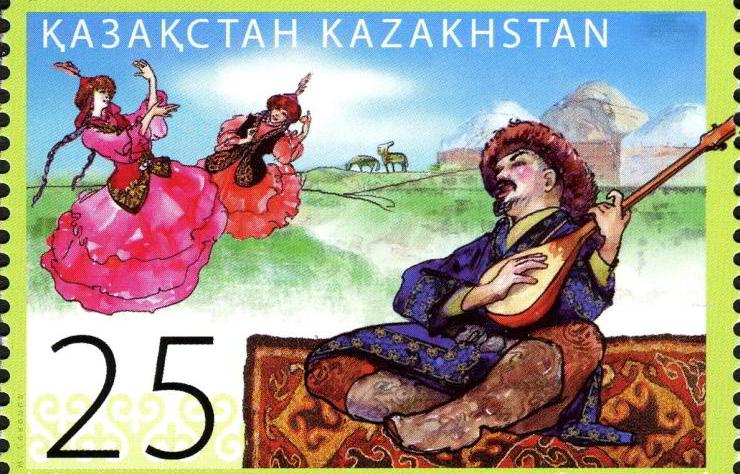
Kazakhstan has been a significant hub of multicultural exchange between East and West. The Silk Road passed through it, and Christians also travelled along it. Excavations in the ancient city of Ili Balik have uncovered an ancient city and a cemetery with eight Christian tombstones, demonstrating that Christianity was present in the country as early as the 7th and 8th centuries. Currently, Christians are a minority, and the Russian Orthodox Catholic Church is the most widespread denomination. (Fernando Féliz) – (Illustration: Post of Kazakhstan)