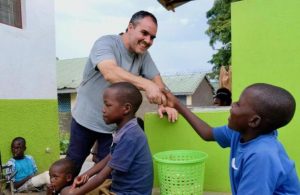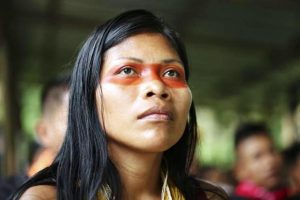
The Comboni Missionary Sisters share their lives with the Palestinian people, particularly the Bedouin community.
One afternoon, Sister Mariolina Cattaneo from Italy stood on the roof terrace of the main Comboni residence in East Jerusalem and pointed to the concrete separation wall, also known as a ‘separation barrier’, which was just yards away.
The section of wall near the Comboni residence was completed in 2009. “Ultimately, walls don’t separate,’” said Cattaneo. “They only divide.” She believes that this particular barrier – about 440 miles long and twice as high as the Berlin Wall in some spots – will one day be dismantled as a relic from a sad era. But right now, the divisions are potent and all too real. Proof of this can be seen in the two groups of Comboni Sisters based in the greater Jerusalem area: one in Bethany (Al-Eizariya in Arabic) on the occupied West Bank, and the other in East Jerusalem, which is also part of the West Bank but claimed by Israel.
Sister Cecilia Sierra, who is from Mexico, said that the separation wall forces the sisters to turn what should be a three-minute walk between the two communities into an eleven-mile journey by car or bus – one that, when traffic is heavy, can take up to two hours. She added that the delay is often worsened by the need to pass through a security checkpoint.
‘It’s one community, but we’re divided by a wall,’ said Sister Sierra, who works in Al-Eizariya alongside Sister Lourdes García, who is also from Mexico. However, Cattaneo and the other Comboni Sisters working in the Jerusalem area – there are seven in total, with five based at the residence in East Jerusalem and the two Mexican sisters based in Al-Eizariya – hope that their presence will act as a bridge in this divided land.
Before Hamas’s brutal October 7, 2023, attacks, abductions, and murders of Israeli civilians, the sisters engaged in efforts to nurture dialogue between Jewish and Palestinian Christian women, such as hosting interfaith and intercultural exchanges at the Comboni residence.
But with the Gaza tragedy, everything stopped, the sisters said. They added that they are more than willing to shepherd such dialogue in the future. But for the moment, they say, continuing security concerns and wariness on both sides make that difficult.
In the meantime, the Comboni Sisters’ ministries continue despite the challenges facing the Holy Land. Sister Lorena Sesatty, also from Mexico, a trained therapist, works in Bethlehem at a counselling service providing psychological support for families, couples, and young people undergoing difficulties not uncommon for residents of the West Bank.
They are facing an economy in tatters, with many unable to return to their jobs in Israel because they cannot renew their security permits, which are a prerequisite for Palestinians. “There is a heaviness right now,” she said, “born from the fact that many cannot work.” “Anger and sadness are closely linked.”
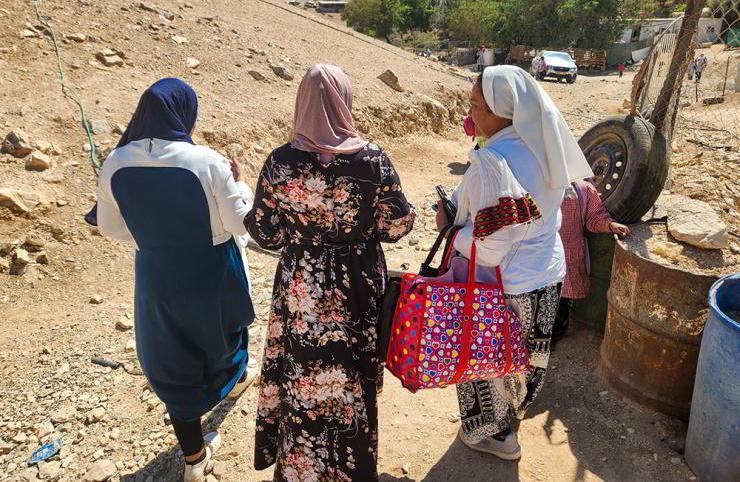
Sister Lourdes Garcia on her way to the Bedouin West Bank community of Al-Eizariya. “When you go into the communities,” she said, “people are traumatized.” In their ministry in the West Bank, Sierra and García encounter that pain all the time.
The Comboni Sisters have been based in Al-Eizariya since 1966. However, they entered a new era in May 2011, when the Bethany community launched its mission in Al-Eizariya and the Bedouin villages of the Judean Desert, which are located east of Jerusalem, after the second intifada.
The Sisters support around two hundred Jahalin Bedouin women from eleven villages by running workshops and providing them with tools, training and resources. These workshops help the women to produce crafts and products, such as embroidery, sewing and soap-making, which provide a valuable source of income for them and their families.
‘It is a vital lifeline that strengthens communities and keeps hope alive,’ said Sierra. “Given the legal restrictions faced by Palestinians, and the particular hardships experienced by the Bedouin – nomadic peoples who are among the most vulnerable in Palestinian society – it is important to affirm the humanity of all,” Sierra said.
“You can’t say one person is a human and another isn’t,” García added. To García, working alongside the Bedouins undergirds the Comboni charism of ministering with the most vulnerable stressing the importance of “us going to them.” “This is their place, not ours,” she said.
For the sisters working in the Bedouin villages, it is important to be seen as “the face of the Church” and as “points of encounter”,’ said García. “That is beautiful for us.” More broadly, she added, it is important not to be overtly political, but to “always be on the side of justice”. It is also important to affirm to the Bedouin communities that “God loves them, that God is still here and that God wants them to live a better life”. (Photo: Comboni Sr. Cecilia Sierra, right, with two residents of the West Bank village of Abu-hindi. Text & photo: Chris Herlinger)