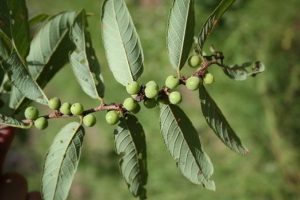
It is commonly known as bush willow and belongs to the plant family Combretaceae. It is a small to medium-sized, semi-deciduous tree, growing to 18 m in height, with a rounded crown.
Bark is light grey, creamy-brown, reddish-brown or brown-black, transversely cracked. Leaves opposite to alternate, simple, narrowly elliptic to broadly ovate, dark green above, paler green to silvery below. Flowers are cream to yellow, up to 5mm in diameter. Fruit 4-winged, rusty red when young, becoming dark brown when mature.
The geographical distribution of Combretum collinum ranges from open woodlands, arid, semi-arid, dry Savanna, deciduous and evergreen thickets, as well as on termite mounds. It can also be found growing up to an altitude of 2,200m above sea level. The plant is highly dominant where it occurs and widespread, extending from South Africa to West Africa, Central Africa up to East Africa.
Combretum collinum is known in different dialects in Africa. For example, it’s called “munondwe” by Bemba people in Zambia, the Baganda tribe of Uganda call it “mukoola”, and the Afrikaans of South Africa call it “boswilg”.
With traditional medicine still one of the main sources of health care for a larger majority of people in Africa and other developing countries, Combretum collinum just like most valuable medicinal plants, still plays a fundamental role in the treatment and management of numerous kinds of diseases.
Its parts such as the leaves, stem bark, and roots, are often sold in local markets and used singly or in combination with other plants to treat many conditions. The preparation of the herbal remedy from Combretum collinum can be inform of infusions, or as a decoction. It can also be ground into powder and mixed with soup, local brew, porridge or milk and then taken. In some cases, the juice/sap from the plant parts is extracted by chewing or pounding, depending on the given disease condition.
The leaf is the most frequently used part of the plant by the traditional healers to treat and manage many disease conditions. For instance, the leaf powder decoction or suspension in water is used for a bath, administered orally, or the powder is put into the fire, and the smoke is inhaled, depending on the targeted disease condition.
The leaf decoction is used as a purgative to relieve one from constipation and for the treatment of malaria. A fresh or dried leaf infusion is widely administered orally as a cholagogue, diuretic, and also taken as a blood tonic. The decoction is also used to treat gastrointestinal problems, including diarrhoea, dysentery, stomach ache and ascariasis condition.
In addition, a combination of leaf and twig decoction is drunk and fresh roots are chewed to treat coughs, bronchitis, tuberculosis, jaundice, as well as snakebites. The leaf sap is applied to treat wounds, leprosy, and is also used as ear drops to treat earache. The crushed leaves are applied as a poultice and also added to bathing water to treat fatigue and rheumatism.
Combretum collinum stem bark powder is eaten in porridge to treat rectal prolapse and haemorrhoids. The hot water bark extract is also used for the treatment of diarrhoea, anal bleeding, malaria, headache and general body pain. The bark also yields an edible/chewing gum which is used to cure a toothache or to plug a carious tooth.
In many African communities, the decoction of Combretum collinum roots is used together with the bark and roots of Kigelia africana for the treatment of excessive menstrual bleeding. Furthermore, the roots of Combretum collinum are boiled and the resultant infusion drunk warm as a treatment for dysentery, diarrhoea, pyomyositis, gonorrhoea, sterility in women, syphilitic sores, toothache and hydrocele in children.
Also, the infusion of the roots of Combretum collinum is used in preparing snake bite antidote that is administered by scarification method or drunk warm to treat snakebite. The juice from the roots is further externally applied to snakebite wounds to maximise the outcome. In addition, patients who suffer from snakebite can also chew the roots of the plant as a treatment. The root infusion is given to women to increase the labour process during birth. The root powder added to petroleum jelly is applied topically or its infusion is drunk for the treatment and management of epilepsy. Just like for the leaves, root infusion is also taken as a blood tonic.
Apart from its immense uses in traditional medicine, Combretum collinum plant is also widely used in wagon building, canoe building and as tool handles. The tree is also used in many homesteads as an ornamental or for shade. Some communities use the root fibres in craft to make basket and other valuable art crafts.
It is a source of firewood, and is planted as firebreaks, especially in savannah type of vegetation. The plant remains one of the most interesting and highly valued medicinal plants in a wide range of communities in Africa, one that can be relied on to treat and manage various disease conditions. (Photo: CC BY-SA 2.5/Marco Schmidt) – (Komakech Richard and Omujal Francis)